
银河系中最常见的行星系统的年轻祖先
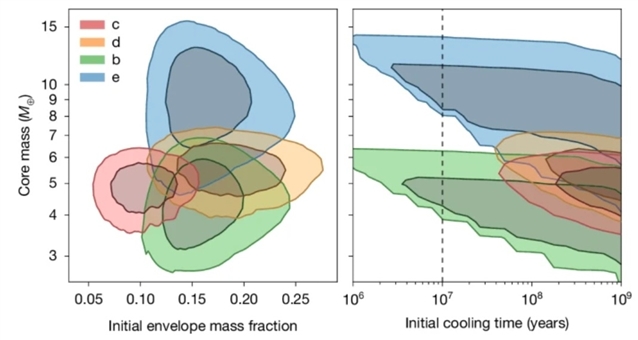
近日,美国加州大学洛杉矶分校Erik A. Petigura团队研究了银河系中最常见的行星系统的年轻祖先。2026年1月7日,《自然》杂志发表了这一成果。
在银河系最常见的行星系统中,有几颗地球到海王星大小的行星在紧凑的轨道上运行。在较小的轨道距离上,较大的行星比较小的行星少一个数量级。年轻的恒星V1298 Tau拥有这样一个紧凑的行星系统,尽管其中的行星非常大(5到10个地球半径)。这些行星形成了一条近共振链,导致凌日时间发生了几个小时的变化。
研究组提出了一个多年的运动,用凌星时间的变化来描述这个系统,一种对恒星强烈的磁活动不敏感的方法。通过有针对性的观测,研究组首先解决了以前未知的最外层行星的轨道周期。从这些数据和档案数据中得出的整整9年的基线,使其能够确定所有行星的质量和轨道参数。
研究组发现这些行星的质量很低,低于海王星,轨道接近圆形,这意味着一段动态平静的历史。它们的低质量和大半径表明,在原行星盘扩散后,内行星立即经历了一段快速冷却的时期。尽管如此,它们的密度比同等大小的成熟行星要小得多。该研究组预测这些行星将缩小到地球半径的1.5-4.0倍,并加入自然界大量产生的超级地球和亚海王星的行列。
附:英文原文
Title: A young progenitor for the most common planetary systems in the Galaxy
Author: Livingston, John H., Petigura, Erik A., David, Trevor J., Masuda, Kento, Owen, James, Nesvorn, David, Batygin, Konstantin, de Leon, Jerome, Mori, Mayuko, Ikuta, Kai, Fukui, Akihiko, Watanabe, Noriharu, Orell Miquel, Jaume, Murgas, Felipe, Parviainen, Hannu, Korth, Judith, Libotte, Florence, Abreu Garca, Nstor, Gallardo, Pedro Pablo Meni, Narita, Norio, Pall, Enric, Tamura, Motohide, Yonehara, Atsunori, Ridden-Harper, Andrew, Bieryla, Allyson, Trani, Alessandro A., Mamajek, Eric E., Ciardi, David R., Gorjian, Varoujan, Hillenbrand, Lynne A., Rebull, Luisa M., Newton, Elisabeth R., Mann, Andrew W., Vanderburg, Andrew, Stefnsson, Gumundur, Mahadevan, Suvrath, Caas, Caleb, Ninan, Joe, Higuera, Jesus, Todorov, Kamen, Dsert, Jean-Michel, Pino, Lorenzo
Issue&Volume: 2026-01-07
Abstract: The Galaxy’s most common known planetary systems have several Earth-to-Neptune-size planets in compact orbits1. At small orbital separations, larger planets are less common than their smaller counterparts by an order of magnitude. The young star V1298 Tau hosts one such compact planetary system, albeit with four planets that are uncommonly large (5 to 10 Earth radii)2,3. The planets form a chain of near-resonances that result in transit-timing variations of several hours. Here we present a multi-year campaign to characterize this system with transit-timing variations, a method insensitive to the intense magnetic activity of the star. Through targeted observations, we first resolved the previously unknown orbital period of the outermost planet. The full 9-year baseline from these and archival data then enabled robust determination of the masses and orbital parameters for all four planets. We find the planets have low, sub-Neptune masses and nearly circular orbits, implying a dynamically tranquil history. Their low masses and large radii indicate that the inner planets underwent a period of rapid cooling immediately after dispersal of the protoplanetary disk. Still, they are much less dense than mature planets of comparable size. We predict the planets will contract to 1.5–4.0 Earth radii and join the population of super-Earths and sub-Neptunes that nature produces in abundance.
DOI: 10.1038/s41586-025-09840-z
Source: https://www.nature.com/articles/s41586-025-09840-z