
从紫外光到近红外光子积分的类纤维损耗
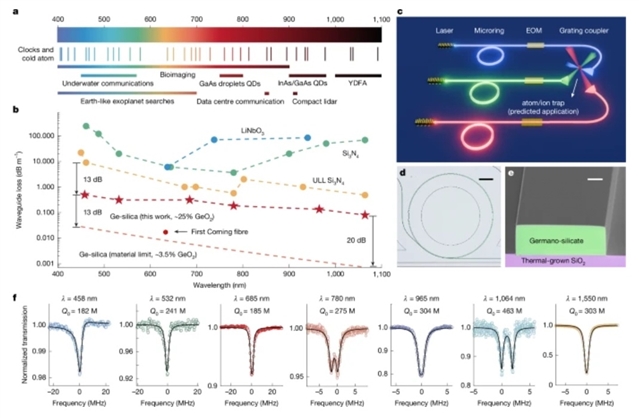
近日,美国加州理工学院Vahala, Kerry团队研究了从紫外光到近红外光子积分的类纤维损耗。该项研究成果发表在2026年1月7日出版的《自然》杂志上。
在过去的几十年里,学界在减少电信频段内光子集成电路(PICs)的损耗方面取得了显著进展,推动了从低噪声光学和微波合成到激光雷达和光子人工智能引擎的片上应用。然而,在较短波长下,材料吸收和散射损耗显著增加,这极大地提高了功率需求,并限制了可见光和近可见光谱范围内的性能。
研究组提出了一种基于锗硅酸盐(构成光纤卓越性能的材料)的超低损耗PIC平台,但该平台是通过完全兼容CMOS代工厂的工艺实现的。这些PICs在从紫光到电信波长范围内实现了超过1.8亿的谐振器Q因子。在电信波段,它们无需热处理即可获得高出10分贝的品质因子,从而扩大了与有源组件异构集成的机会。该平台的其他特性包括易于设计的波导色散、声模限制以及大模面积诱导的热稳定性——分别通过孤子微梳生成、受激布里渊激光发射和低频噪声自注入锁定来证明。
这些锗硅酸盐PICs的成功最终将实现芯片上的类光纤损耗,使波导损耗比当前最高性能的光子平台再降低20分贝。此外,研究组所展示的性能能力将超低损耗PIC技术与光学时钟、精密导航系统和量子传感器相结合。
附:英文原文
Title: Towards fibre-like loss for photonic integration from violet to near-infrared
Author: Chen, Hao-Jing, Colburn, Kellan, Liu, Peng, Yan, Hongrui, Hou, Hanfei, Ge, Jinhao, Liu, Jin-Yu, Lehan, Phineas, Ji, Qing-Xin, Yuan, Zhiquan, Bouwmeester, Dirk, Holmes, Christopher, Gates, James, Blauvelt, Henry, Vahala, Kerry
Issue&Volume: 2026-01-07
Abstract: Over the past decades, remarkable progress has been made in reducing the loss of photonic integrated circuits (PICs) within the telecom band1,2,3,4, facilitating on-chip applications spanning low-noise optical5 and microwave synthesis6, to lidar7 and photonic artificial intelligence engines8. However, several obstacles arise from the marked increase in material absorption and scattering losses at shorter wavelengths9,10, which prominently elevate power requirements and limit performance in the visible and near-visible spectrum. Here we present an ultralow-loss PIC platform based on germano-silicate—the material underlying the extraordinary performance of optical fibre—but realized by a fully CMOS-foundry-compatible process. These PICs achieve resonator Q factors surpassing 180 million from violet to telecom wavelengths. They also attain a 10-dB higher quality factor without thermal treatment in the telecom band, expanding opportunities for heterogeneous integration with active components11. Other features of this platform include readily engineered waveguide dispersion, acoustic mode confinement and large-mode-area-induced thermal stability—each demonstrated by soliton microcomb generation, stimulated Brillouin lasing and low-frequency-noise self-injection locking, respectively. The success of these germano-silicate PICs can ultimately enable fibre-like loss onto a chip, leading to an additional 20-dB improvement in waveguide loss over the current highest performance photonic platforms. Moreover, the performance abilities demonstrated here bridge ultralow-loss PIC technology to optical clocks12, precision navigation systems13 and quantum sensors14.
DOI: 10.1038/s41586-025-09889-w
Source: https://www.nature.com/articles/s41586-025-09889-w