
硅中的11量子位原子处理器
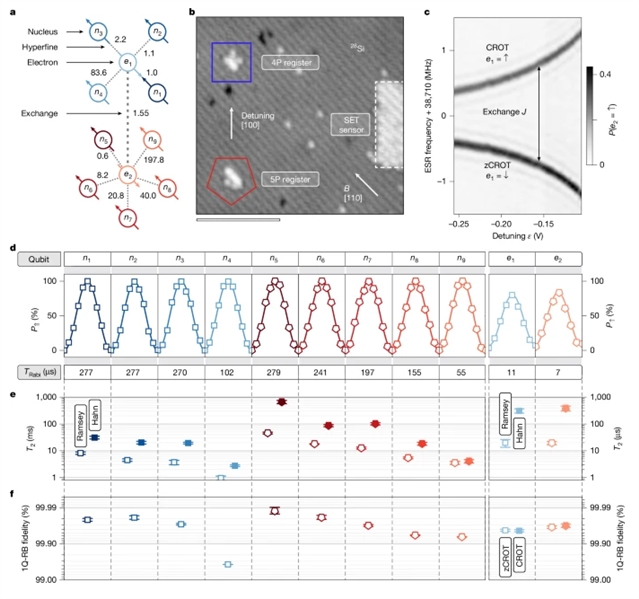
近日,澳大利亚新南威尔士大学悉尼分校Michelle Y. Simmons团队研究了硅中的11量子位原子处理器。2025年12月17日出版的《自然》杂志发表了这项成果。
硅中的磷原子是构建量子计算平台的一个极具前景的载体,因为其核自旋具有长达数秒的相干时间,并能实现高保真度的读取与单量子位控制。当将数个磷原子置于纳米半径范围内时,它们会通过超精细相互作用耦合到一个共享的电子上。这样的核自旋寄存器能够实现高保真度的多量子位控制并运行小规模量子算法。要实现规模扩展,一个关键要求是能够在多个自旋寄存器之间实现非局域的高保真度纠缠。
研究组利用一个由两个多核自旋寄存器组成的11量子位原子处理器来应对这一挑战,这两个寄存器通过电子交换相互作用进行连接。通过改进校准与控制协议,研究组实现了保真度均在99.10%至99.99%之间的单量子位门与多量子位门。通过对所有局域及非局域核自旋对进行纠缠,研究组全面评估了处理器的性能,并获得了高达99.5%的贝尔态保真度,达到了当前最高水平。随后生成了量子位数逐渐增加的Greenberger–Horne–Zeilinger(GHZ)态,并展示了多达八个核自旋的纠缠。通过在互连的核自旋寄存器之间实现高保真度的操作,研究组实现了原子处理器迈向容错量子计算的关键里程碑。
附:英文原文
Title: An 11-qubit atom processor in silicon
Author: Edlbauer, Hermann, Wang, Junliang, Huq, A. M. Saffat-Ee, Thorvaldson, Ian, Jones, Michael T., Misha, Saiful Haque, Pappas, William J., Moehle, Christian M., Hsueh, Yu-Ling, Bornemann, Henric, Gorman, Samuel K., Chung, Yousun, Keizer, Joris G., Kranz, Ludwik, Simmons, Michelle Y.
Issue&Volume: 2025-12-17
Abstract: Phosphorus atoms in silicon represent a promising platform for quantum computing, as their nuclear spins exhibit coherence times over seconds1,2 with high-fidelity readout and single-qubit control3. By placing several phosphorus atoms within a radius of a few nanometres, they couple by means of the hyperfine interaction to a single, shared electron. Such a nuclear spin register enables high-fidelity multi-qubit control4 and the execution of small-scale quantum algorithms5. An important requirement for scaling up is the ability to extend high-fidelity entanglement non-locally across several spin registers. Here we address this challenge with an 11-qubit atom processor composed of two multi-nuclear spin registers that are linked by means of electron exchange interaction. Through the advancement of calibration and control protocols, we achieve single-qubit and multi-qubit gates with all fidelities ranging from 99.10% to 99.99%. By entangling all combinations of local and non-local nuclear-spin pairs, we map out the performance of the processor and achieve state-of-the-art Bell-state fidelities of up to 99.5%. We then generate Greenberger–Horne–Zeilinger (GHZ) states with an increasing number of qubits and show entanglement of up to eight nuclear spins. By establishing high-fidelity operation across interconnected nuclear spin registers, we realize a key milestone towards fault-tolerant quantum computation with atom processors.
DOI: 10.1038/s41586-025-09827-w
Source: https://www.nature.com/articles/s41586-025-09827-w