
南大洋的夏季变暖由风暴驱动混合调节
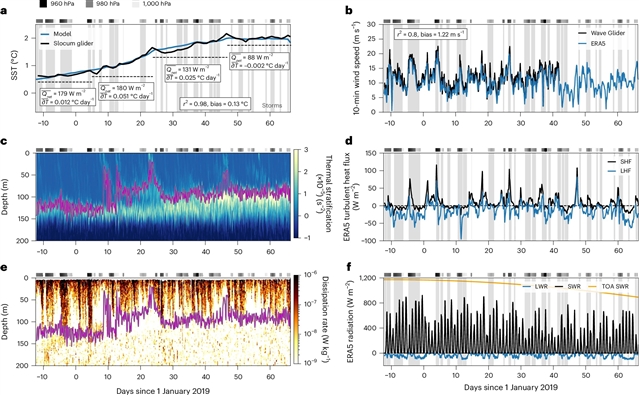
南大洋的夏季变暖是由风暴驱动的混合调节的,这一成果由哥德堡大学Sebastiaan Swart小组经过不懈努力而取得。该研究于2025年12月3日发表于国际一流学术期刊《自然—地球科学》杂志上。
在这里,该课题组研究了风暴对夏季南大洋表面温度年际变化的影响,主题是水下和水面机器人车辆的原位观测,气候再分析和卫星数据。该研究组发现天气尺度风暴通过改变混合层的有效热容和从下面夹带较冷的水来调节夏季海面温度。风暴通过限制到达海面的太阳辐射减少了夏季海洋的热增益。由于湍流的海气交换而减少的热损失部分地抵消了这种影响。课题组研究人员还发现,夏季南大洋海面温度的年际变化是由风暴平均风速的变化驱动的,而风暴平均风速的变化与南环模有关。他们的研究结果证明了风暴强迫和海面温度变化之间的气候联系,这对于减少气候模式中的变暖偏差和改善未来气候预测至关重要。
据介绍,南大洋吸收了气候变化产生的大部分多余热量。然而,气候预估显示其海面温度持续偏暖夏季,表明对控制该地区的海气热交换机制的了解有限。
附:英文原文
Title: Southern Ocean summer warming is regulated by storm-driven mixing
Author: du Plessis, Marcel D., Nicholson, Sarah-Anne, Giddy, Isabelle, Monteiro, Pedro M. S., Prend, Channing J., Swart, Sebastiaan
Issue&Volume: 2025-12-03
Abstract: The Southern Ocean absorbs most of the excess heat resulting from climate change. However, climate projections show a persistent warm summer bias in its sea surface temperatures, indicating a limited understanding of the air–sea heat exchange mechanisms governing this region. Here we examine the impact of storms on the interannual variability of Southern Ocean surface temperatures during summer using in situ observations from underwater and surface robotic vehicles, climate reanalyses and satellite data. We show that synoptic-scale storms regulate summer sea surface temperatures through alteration of the effective heat capacity of the mixed layer and the entrainment of colder water from below. Storms reduce the summer ocean heat gain by limiting solar radiation reaching the surface. This effect is partially offset by a reduction in heat loss due to turbulent air–sea exchange. We also find that interannual variations in sea surface temperature during summer in the Southern Ocean are driven by changes in storm-mean wind speeds, which are linked to the Southern Annular Mode. Our results demonstrate a causal link between storm forcing and sea surface temperature variability, which is critical for reducing warming biases in climate models and improving future climate projections.
DOI: 10.1038/s41561-025-01857-3
Source: https://www.nature.com/articles/s41561-025-01857-3